Michael Levin’s Platonic space of minds: what the experiments actually show
By The Giant’s Shoulder
Start here: Michael Levin in three chapters · All field guides
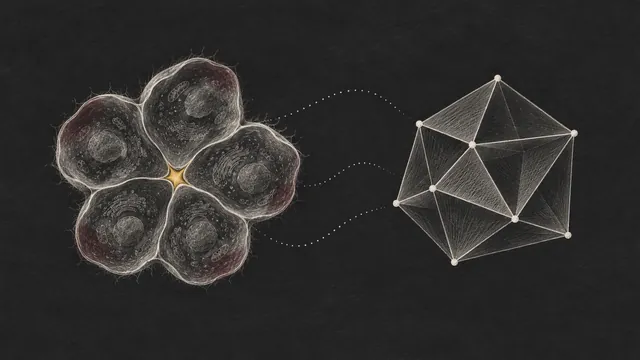
A flatworm can grow a new head. In one experiment, some flatworms grew two. The stranger result came later: when the researchers cut them again, some worms that had looked normal produced two heads. Something about their earlier state had carried forward even when their anatomy gave no sign of it. That’s the empirical puzzle. Michael Levin’s “Platonic space of minds” is one much bigger proposal about where the patterns that shape living things might come from.
What can cells do without a blueprint?
DNA matters. It helps build the machinery that lets cells signal, respond to neighbours and coordinate. But knowing which genes the cells carry doesn’t necessarily tell you what those cells will build in a particular situation.
In frog embryos, Pai and colleagues found that changing the voltage across cell membranes could change where eye structures formed. And in the flatworm study by Durant and colleagues, a temporary change in bioelectric signalling could shift what some worms regenerated, even in later rounds. “Pattern memory” here means that the system’s earlier state affects what it builds next. It doesn’t mean a tissue remembers an event the way you do.
Start with Levin and neuroscientist Earl K. Miller at 12:36, on how cells build an eye together. Then go to Levin’s solo conversation at 11:16, on what counts as intelligence in living tissue. The question sharpens at 48:57, on what would count as evidence of consciousness. Coordinating toward a result and having a subjective experience are two different claims.
What does Levin mean by a “Platonic space of minds”?
At 1:13:28 with Earl Miller, Levin turns from how cells communicate to a harder question: why do certain forms and behaviours turn up at all? Think of the same mathematical pattern appearing in two very different systems. You can ask what physical processes produce it in each. You can also ask why the same pattern was available to both systems in the first place.
Levin takes that second question literally. In his 2026 Ingressing Minds article in Philosophies, he proposes that living bodies can give expression to patterns that aren’t fully explained by genes and environment. His stronger suggestion is that some of those patterns might themselves have agency. The frog and flatworm work doesn’t establish a realm of minds independent of bodies. A useful test would be to specify a result in advance that the Platonic account predicts better than a model based on cell signalling, feedback and physical constraints.
The best next chapter is 1:20:44, where the conversation asks whether the ordinary explanation is simply incomplete.
Is this the same as Donald Hoffman’s theory?
No. Levin starts from what living systems build and asks where the forms and behaviours they can express come from. Hoffman and Chetan Prakash start with a mathematical model of interacting conscious agents and ask how perceived objects and spacetime might arise from their interactions. The two ideas ask different questions, and the bioelectric findings don’t verify either metaphysical claim. Hear Hoffman make his own starting point explicit in his separate Giant’s Shoulder episode at 43:10.